Selection can become subjective
Without explicit rules, a benchmark can depend on which organisms happen to be familiar, interesting or convenient.
 BacSelect
We need a manageable set of bacterial genomes. Which ones?
Choose how many genomes you can realistically analyse. BacSelect returns a deterministic panel from the immutable 2026.09 release universe that spans bacterial genome architecture, while controlling the influence of heavily represented species.
Even N=500 represents only 0.73% of the eligible universe.
BacSelect 2026.09 is the current immutable monthly release.
Conceptual diversity map · positions are illustrative, not measured validation coordinates.
This panel is drawn from the immutable BacSelect 2026.09 source universe using the frozen OPS selector.
Choose N to obtain the corresponding BacSelect 2026.09 panel. Preset downloads are immutable release artifacts; custom N is the exact prefix of the same frozen OPS ladder.
These figures describe the frozen development universe used to design and validate BacSelect. They remain provenance values and are distinct from the current 68,164-genome BacSelect 2026.09 release universe.
Public archives contain tens of thousands of complete bacterial genomes. Most benchmarking and method-development projects can analyse only a fraction of them. The subset you choose changes what your method is tested against.
BacSelect turns that choice into an explicit, deterministic and versioned step.
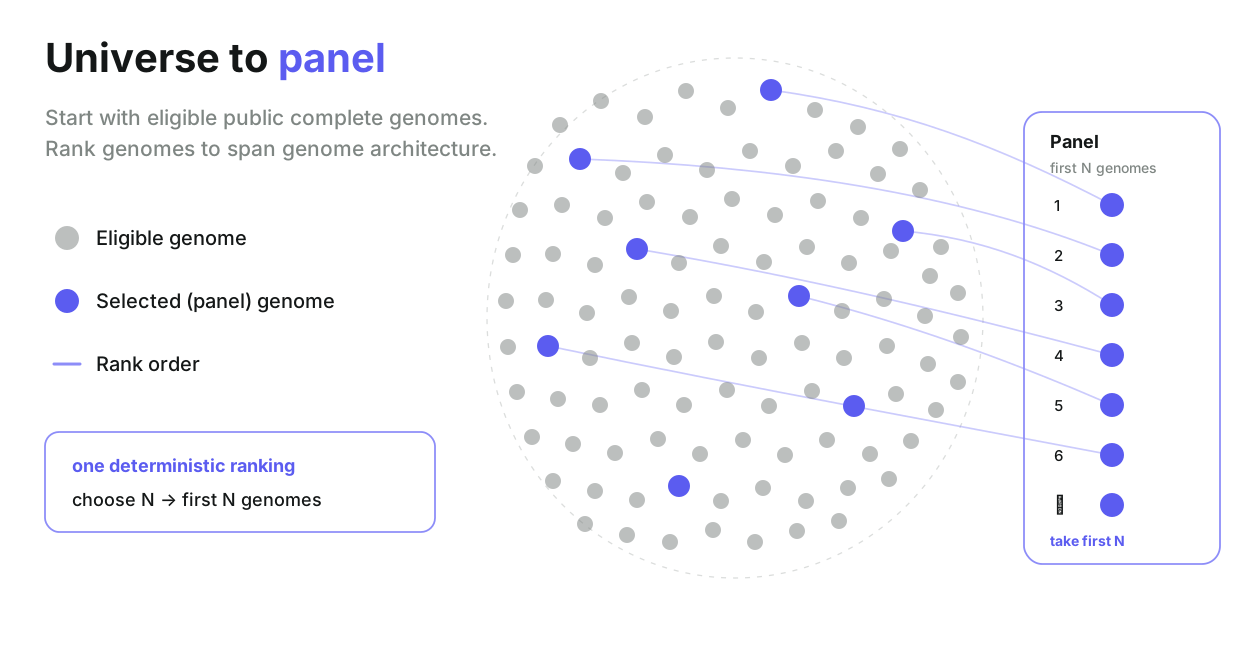
Without explicit rules, a benchmark can depend on which organisms happen to be familiar, interesting or convenient.
Species represented by thousands of assemblies should not dominate the selection geometry simply because they have been sequenced more often.
For a fixed release, selector version and N, the same validated inputs return the same ordered panel.
N does not change the kind of genome architecture BacSelect seeks. It changes how densely the same release universe is sampled.
Smaller panels reduce downstream compute. Larger panels provide denser structural representation, at greater computational cost.
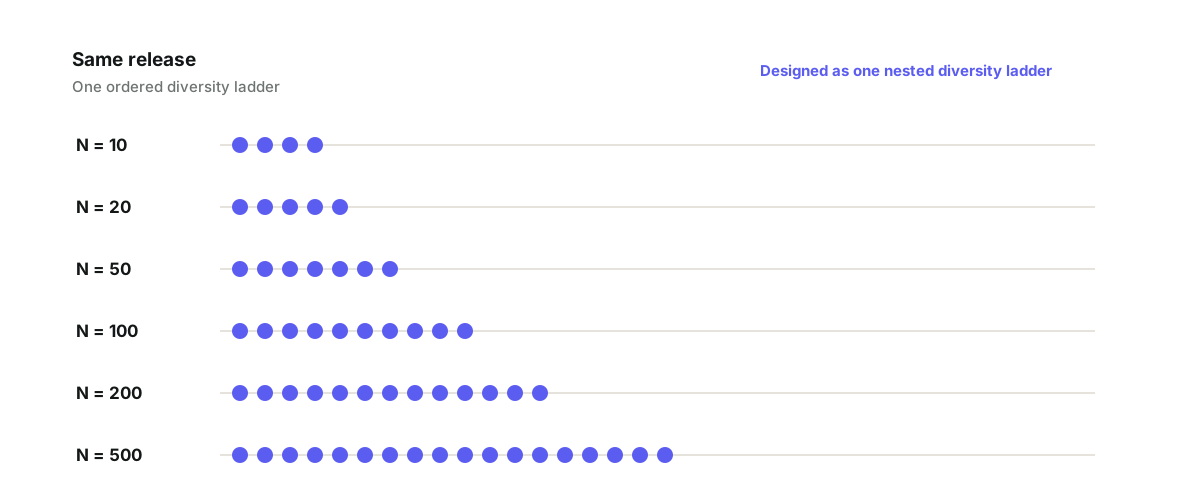
These are practical compute–resolution trade-offs, not biological categories or claims that a particular N is correct for a particular study.
For expensive workflows, rapid checks, or situations where downstream compute and manual review are strongly limiting.
More representatives sample the same genome-architecture space more densely, with a corresponding increase in downstream compute.
The densest supported sampling of the defined release universe, while still representing only a small fraction of eligible genomes.
Scale boundary: even the largest supported panel, N=500, selects only of the 68,164 eligible genomes in the current 2026.09 release universe.
BacSelect quantifies structural representation directly within each defined release universe. BacSelect 2026.09 is the first dated release with release-specific structural-coverage results.
For every eligible genome, the distance to its nearest selected panel genome is measured in the validated architecture space. Release summaries use species-balanced weighting so heavily represented species do not dominate the reported distribution. Smaller distances mean denser structural representation.
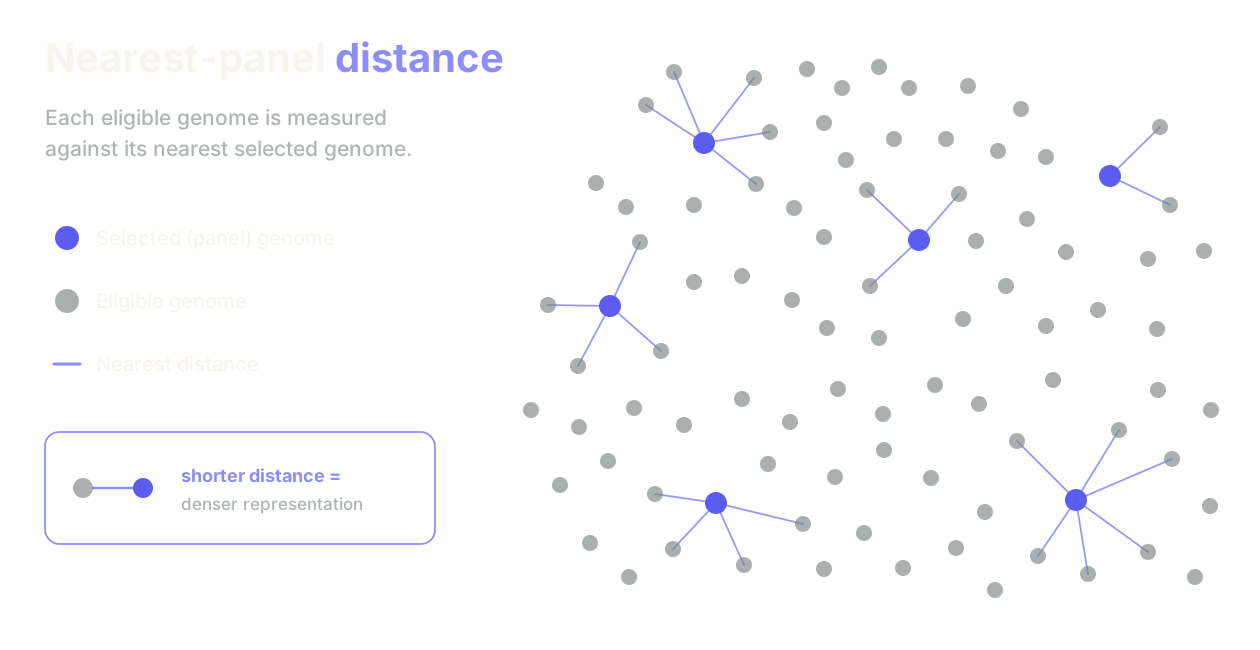
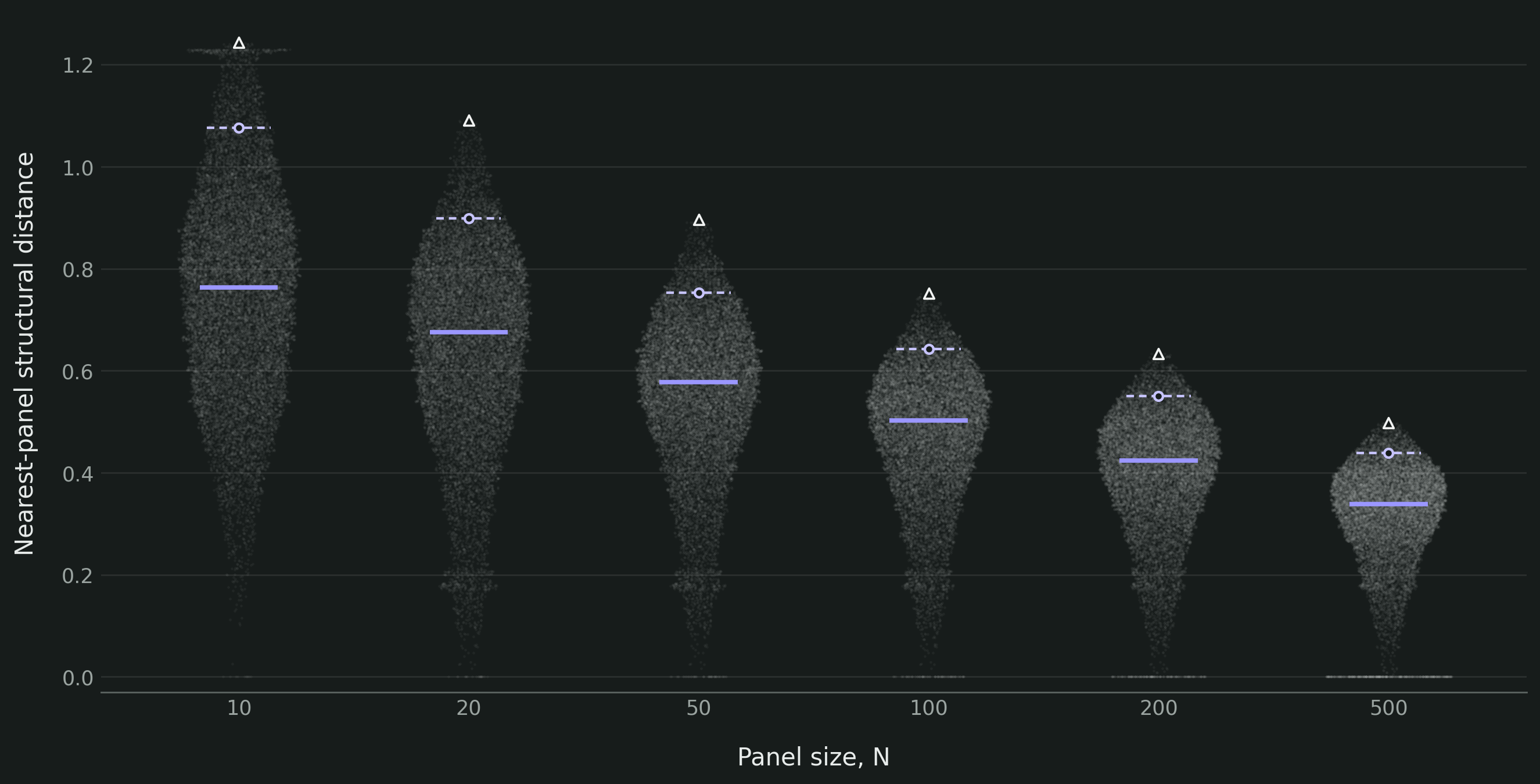
Distances are measured in BacSelect's validated architecture space. Panel sizes are discrete evaluated panels; summary values are not connected or interpolated between N values.
BacSelect v1 works from eligible complete bacterial genome assemblies in the INSDC / GenBank assembly archive, retrieved reproducibly through NCBI Datasets.
NCBI Datasets is the retrieval interface. It is not a claim that NCBI is the only bacterial genome resource. Other genome collections exist and are not automatically incorporated into the BacSelect v1 universe.
BacSelect does not represent all bacterial life. Its source universe reflects what has been sampled, sequenced, assembled to completion, deposited and classified. BacSelect can reduce arbitrary selection within that defined universe; it cannot remove biases already present in the underlying data.
BacSelect uses identity-blind, deterministic, diversity-seeking selection.
The aim is specific: build compact panels that span observed bacterial genome architecture, while controlling the influence of species that are heavily represented in the public archive.
Organism name, pathogen status, clinical relevance, publication history and expected software performance are not selection variables.
Start from a versioned collection of eligible public complete bacterial genome assemblies. The exact source snapshot and eligibility rules belong to the release provenance.
Represent each eligible genome using sequence-derived structural features such as genome size, GC content, replicon structure and repeat architecture.
Construct the feature geometry so that species with thousands of deposited genomes do not automatically dominate species represented by only a few.
For a fixed release, selector version and panel size, the same inputs produce the same ordered result. Selection does not depend on organism identity.
The pre-specified selector validation is complete. OPS is the frozen selector for selector v1.0.0, the official selector-v1 reference panels have been independently rebuilt byte-for-byte, and BacSelect 2026.09 is the first dated monthly production release.
Selector v1.0.0 and its nested reference panels at N=10, 20, 50, 100, 200 and 500 are frozen. Custom N from 10–500 is the exact prefix of the same verified ladder. This reference set is not labelled with a monthly YYYY.MM release.
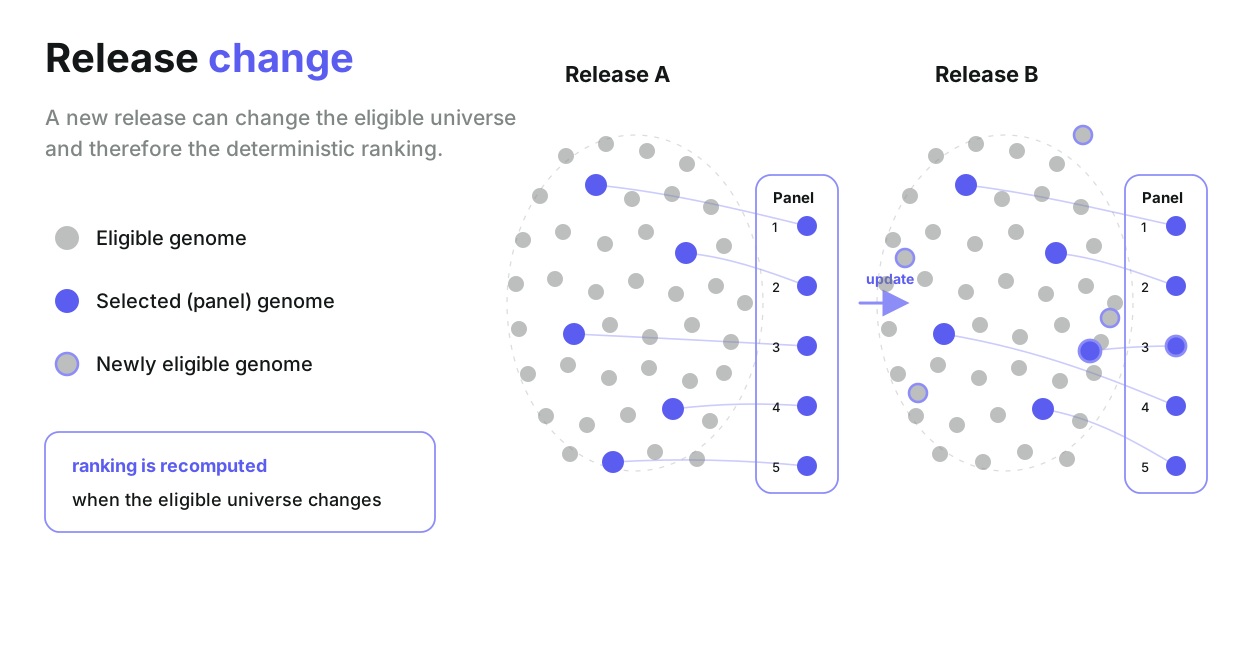
BacSelect monthly releases are immutable snapshots. 2026.09 is the first dated production release; the selector-v1 reference panel remains available independently as validation provenance.
Each release records the exact eligible assembly universe, taxonomy state, structural-feature schema and upstream provenance used for selection.
Released panel sizes are tied to the release identifier and selector version, so a reported BacSelect panel can be reconstructed exactly.
The 2026.09 release includes machine-readable genome lists, metadata, selection provenance, structural-coverage results and SHA256 checksums.
Because 2026.09 is the first dated BacSelect release, there is no preceding monthly universe for turnover comparison. Future releases can measure universe, panel and structural-coverage changes against this immutable baseline.
BacSelect 2026.09 uses the independently versioned 1 September 2026 source snapshot containing 68,164 eligible complete genomes across 16,223 species groups. The selector-v1 reference set remains separate validation provenance.
For most studies, BacSelect belongs in the Methods because it defines how the genome set was selected. Results need only discuss BacSelect when the composition or structural coverage of the selected panel is itself being analysed.
Complete bacterial genomes were selected using BacSelect release 2026.09 (selector v1.0.0, architecture schema v1, N=100).
Core BacSelect panel selection, metadata, citation guidance and release history will remain freely accessible.
“We need a manageable set of bacterial genomes. Which ones?”
BacSelect grew from a practical benchmarking problem: more than 55,000 eligible complete bacterial genomes were available, but only a small number could be analysed realistically. Choosing that subset by hand would make the benchmark depend on subjective choices. BacSelect was developed to make that selection reproducible, explicit and measurable.